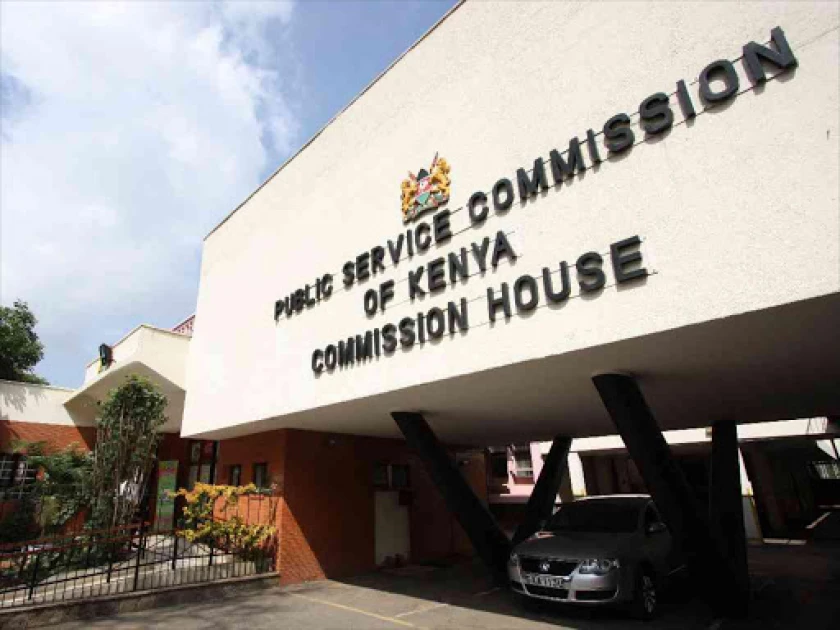
Kalenjins and Kikuyus have maintained their stronghold in Kenya’s public service, claiming a large share of new government appointments despite directives from the Public Service Commission to promote ethnic balance.
According to a fresh PSC report covering the period ending June 30, 2025, the two communities secured more than one-third of all new positions across ministries, state departments, and agencies.
A total of 7,224 new staff members were hired during the period. Kalenjins led with 1,250 appointments, accounting for 17.3 per cent, while Kikuyus closely followed at 1,208, representing 16.7 per cent. Combined, the two groups obtained 2,458 positions, equivalent to 34 per cent of all new hires.
Other communities filled fewer roles: the Luhya had 924 new hires, Luo 839, Kamba 551, and Kisii 517. Minority groups and marginalized communities recorded very low numbers: 371 Merus, 232 Mijikendas, 224 Maasais, 208 Somalis, and 100 Embus joined the workforce.
Some communities were represented in single or double digits—Ogiek (1), Waat (1), Wardei (2), Taveta (2), and Elmolos (3). Tharakas got 66 positions, Teso 64, Pokots 67, and Boranas 54.
The PSC has repeatedly highlighted the persistent overrepresentation of Kikuyu and Kalenjin communities in state employment, a trend tracing back to the presidency’s historical dominance.
Earlier, the two groups also accounted for the majority of 8,447 new appointments made under Kenya Kwanza up to December 2024.
In response to the disparities, the PSC instructed public agencies to follow a prescribed formula for ethnic balance and to develop affirmative action programmes by June 30, 2025.
However, the report shows the instructions have not translated into noticeable change, with ten ethnic communities holding almost 90 per cent of jobs, and five communities occupying 70 per cent of positions in state corporations.
By December 2024, PSC records indicated 47,543 Kikuyus and 40,820 Kalenjins in the public service, forming 20 per cent and 17.6 per cent of the workforce respectively.
The report also found that 29 institutions had over half of their employees from a single ethnic community. The skewed representation is largely linked to non-competitive recruitment processes across state corporations, ministries, and public universities.
Public institutions are expected to uphold merit-based hiring and promotion principles, except in cases intended to address underrepresentation of gender, ethnic communities, or persons with disabilities. Attempts to introduce regulations aimed at correcting ethnic imbalances have yet to receive full approval.
The PSC defended its operations, emphasizing that appointments are guided by “meritocracy, fairness, transparency, and inclusivity.”
However, the report details internal challenges undermining the commission’s effectiveness, including chronic underfunding with a 41 per cent budget gap and a 44 per cent vacancy rate among its staff. “The commission’s wide mandate scope covering 585 public organisations, coupled with disproportionately low budget allocation, contributes to significant delivery frictions and missed targets,” the report notes.































Comments
Sign in with Google to comment, reply, and like comments.
Continue with Google